Thursday, February 9, 2012

Quiet time at home

We've learned how to maintain two fires here - one in the sala, or living room, and one in the master bedroom. Both get lit at about 7 p.m. on an ordinary day (earlier if the weather is cooler). When we go to bed we leave the one in the living room to burn out and add wood to the one in the bedroom. I woke up at 4 a.m. and there were still embers. Hacienda Cusin delivers wood every morning.

I remember when I first lived in Oregon 30 years ago and how we'd go out into the woods and cut down a tree, then use a chain saw to cut it up. Once home, we'd split the wood and stack it. It was a virtuous activity. Now we have a gas fireplace and we just push the button. At first, here, I wished it were easier to get warm in the evening. Now I love how we can do it for ourselves.


Sounds: roosters from El Monasterio; a dog barking in San Pablo; horses clopping as Cusin guests embark on a trail ride; a grosbeak tapping on our window in the morning - maybe the light at that time reflects off the window so he sees himself; an Andean flute - maybe just over the wall in the mestizo section of the cemetery, or out on the road; the evening fire snapping and popping or the thud of a half-burned eucalyptus log falling from the grate to the bricks on the floor of the fireplace; a sound like hollow wooden percussion instruments - some kind of frog, I'm told; multiple birdsongs; distant chants from San Pablo; clock ticking; Art bringing in a load of wood from the porch; the voice of my Rosetta Stone instructor; Venancia cooking locro (potato cheese soup), made with papas, queso fresco, lechera y aguacate (potatoes, cheese, milk and avocado).

Wednesday, February 8, 2012

To Otavalo again

Yesterday afternoon we met our neighbor Virginia. She'd been waiting to introduce herself until we'd settled in and acclimated to the altitude. Virginia is an artist; she's Italian born but has lived for years in the United States, in Hawaii and New York, and is now renting one of the five casas on the property for a year. One of her first kindnesses to us was to fix us a cup of coca tea, which she said is a required daily drink on a high-altitude trek or horseback ride. Art and I have had headaches since we got here, and Virginia said the tea would get rid of the headache.

It did! We woke up this morning at our regular home time and without a headache.

Her second kindness was to invite us to taxi with her to Otavalo again. We walked all over town as she did her errands. I stopped in a little shop and bought souvenirs for my twin granddaughters, my neighbor and my neighbor's daughter - plus something for me. Hand-made things, beautiful and locally made. We spent time in the fruit and vegetable market and picked up a container of some kind of fruit I can't identify. They grow inside a paper-thin cap.


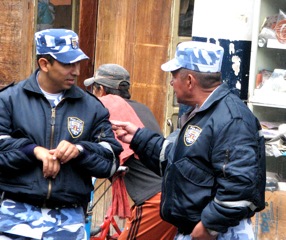
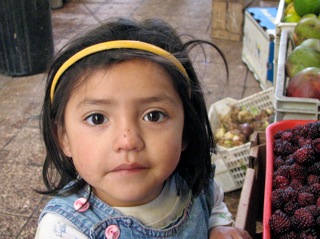
I was conscientious about not taking photos of people, but Art was surreptitious and used his telephoto lens to capture some images:

Tuesday, February 7, 2012

Traveling styles

My path to wi-fi:

Past the llama grazing in the common area

Down the path to Hacienda Cusin

My internet cafe


When I met Art he had no interest in traveling. He said, "I was in California and Viet Nam when I was in the service. That was enough." I'd been raised in the military and had gone through the military experience with my first husband, so it was not quite a habit. The first trip Art and I took together was to Central Washington, for a Kenny G concert at the Gorge and an overnight at the Best Western Ellensburg, with his best friend. The next year we rented a motorhome and spent a week at Derry's Resort near Leavenworth, Washington, with six kids of ours or someone else's. The next year we went to Whistler, then to Bryce/Zion/Grand Canyon. Then Ireland. Now, 15 years later, we do a lot of traveling, and Art lists it among his hobbies.

I'm a planner. I like to know where we'll be staying and when, how we'll be getting around. I like to know where the ATMs are along the way. On our three-week road trip last spring, I had our route planned each day, and we followed that schedule just about exactly except for once, when we decided to stay one day longer in Iowa.

Art's not a planner on the road. But he has an independent spirit.

Here's my idea. Hire Jorge, the driver who brought us from Quito. Have him take us there and wait while we do our shopping, then bring us back. His services would cost about $30. Here's my next idea. Take a bus to Otavalo - we catch it in San Pablo and it costs 25 cents each way. But take Venancia with us so she can show us where the store is, where the bookshop is, where the market is. Here's Art's idea. Take the bus to Otavalo and figure it out as we go.

I said, well, okay. If you want to do that, then you be the leader and I will be the follower. Art rolled his eyes and refused to agree to my proposition.

So we have a style difference here. I'm not an exploring kind of traveler; Art is. I want to minimize risk and maximize safety; Art isn't as concerned about that as I am. Seems odd, seeing as how I've done so much more traveling in my life than he has.

Today we took the local bus to Otavalo, a larger town about 15 miles from San Pablo. After disembarking at the regional terminal, we asked twice for instructions to Aki, a market, where we picked up groceries we can't get at the tiendas in San Pablo. The market reminded us of the one we visited last spring in Gordon, Nebraska, which provides the primary shopping for a town of 1500 people. We'll be returning tomorrow to visit the fruit and vegetable market.

When we got off the bus in San Pable, we had to fight our way past a scramble of boys just out of school.


Rear shots aren't the same as taking pictures!

Monday, February 6, 2012

Casa Quinde and About

An Ecuadorian potato dish was on the menu for last night. Venancia had asked me for $5 for the potatoes; when she arrived, she gave me a dollar in change and a plastic bag containing at least 100 potatoes! Venancia made chicken, broccoli, potato pancakes and a salad. And a salsa for Art, from a chili and a fruit called, I think, tomato de arbol. He pronounced it delicious. I took a taste on one fingertip and my mouth suffered for 10 minutes.

We are reading, mostly, as our bodies acclimatize. Our hosts have a small library full of books I'd thought about reading but never got around to. I just started The Time Traveler's Wife and wonder why I didn't read it when it first came out. Art is reading a recent issue of The Sun where the theme is work and lack of work; we're both interested in this as we watch our children dealing with the current economy.

In the back yard of Casa Quinde I can't help taking pictures. Someone who lives in this house has a wonderful eye for placement of plants, and the God of this area has blessed it with spectacular scenery, both close up and distant. I hope we can drag ourselves away from the house and explore the surrounding area.

Bird feeding station, Casa Quinde front porch, clothesline amid the fuschias

We walked into the village of San Pablo this afternoon. It's just outside the gate of our compound. I noticed the adults didn't make eye contact with us as we passed. I wonder if that's part of their culture like it is for the Lakota Sioux we learned about last spring in the Black Hills. We stopped at a panaderia (bakery) for a couple of pastries for which we paid a total of 60 cents. At a tienda (small shop) we hoped to buy an onion, but I didn't know the word for onion and my dramatic rendition of cutting one and then weeping elicited giggles from the children gathered around, but no onion.

Out of respect, we didn't take any pictures of the people we saw, except for one: I sat on a bench and behind me four teenage girls sat on another, talking and giggling, and Art set up a camera shot of them that looked like he was taking a picture of me. Sneaky, but respectful!


We shared the road with cars, pedestrians and animals.


We explored the cemetery as well. We'd been told the indigenous people are buried at the back of the cemetery, in the ground, but mestizos (mixed indigenous and Spanish from colonial times) are buried in the front of the cemetery, above ground in niches.


As we were returning to the gate, a young boy approached, kicking a soccer ball. I blocked the kick and my return went straight into an empty niche! The boy and his friend backed away. I looked around for a long stick but didn't see one, so I crawled in about four feet and retrieved the ball. When I emerged, the boys were at least 15 feet from me, watching. I tossed them the ball. "Lo ciento," I apologized. I think I might have violated sacred ground or something. I did check my hoodie and my shirt to make sure no large venomous spiders had attached themselves to my clothing.

At the wi-fi I found a google translator and began my own little dictionary: onion is cebolla; dessert (so I can ask Venancia to make us a local one) is postre; ice cream (so I can find some!) is helado. This is called just-in-time learning!


Sunday, February 5, 2012

Life at Casa Quinde - Day 1


Front porch, Casa Quinde

Over Casa Quinde's back wall


Neighbors

Delicious Ecuadorian fruit!

We have a housekeeper, Venancia, who comes three hours a day. She makes $3 an hour and is putting her son Jonathan through the university at Ibarra, a city about an hour north of her via the Pan American highway. She lays the fires in the sala (living room) and bedroom; there's no central heating here, so we need the warmth at night when the temps drop from the mid 60s to the low 50s. She made up our bed; Art is allergic to feathers so Venancia replaced the down comforters with a polyester one in a cotton duvet and covered it over with a heavy wool bedspread. She cooks if we want that. Last night we had chicken from the grill, brussels sprouts picked from the garden at Hacienda Cusin (the hotel/lodge on whose property we are located) and sauteed with garlic in olive oil, and a salad from the same garden. Hacienda Cusin has the wi-fi I need, so I'll be taking the five-minute stroll to their library every couple of days to post what I've written.

I learned how to clean vegetables by soaking them in water with a capful of Vitalin, a disinfectant for fruits and vegetables. As I watched her, Venancia asked me how I clean vegetables at home; I told her the water is clean from the tap and she looked surprised. I already know how to brush my teeth using water from a bottle, but it's harder to remember here since everything we've seen so far has looked clean.

We went to bed at 7:30 the first night (Ecuador is in the same time zone as the East Coast of the US) and slept for 13 hours! And after breakfast I went back to bed for a two-hour nap. Catching up, I guess. Plus, at 8500-foot elevation, my body has some work to do in the next few days getting me ready to live here.

What I've learned:

1. How to run a fancy washing machine with all Spanish instructions.

2. That I remember how to use a clothesline. I hung the laundry on lines strung between enormous fuschia plants. There is a dryer at the hotel, and I can use it if the door is unlocked. Not sure about the hours of operation, since Elena, the woman I met there while exploring, used words not yet in my Spanish vocabulary. Apparently Venancia has a key and will take the clothes to the dryer if it's raining, but I'm not yet accustomed to being royalty, so I feel odd having someone else do that work for me.

3. That I need a more robust Spanish-English dictionary than the one I brought. It doesn't have the word "visitor" or "guest", which is how I want to introduce myself. I'll look for a dictionary when we're out and about, or I'll write down a list of words I want to know and look them up on an online translator when I'm using the wi-fi.


Saturday, February 4, 2012

To our destination - Casa Quinde, Imbabura, Ecuador

Our second attempt to fly to Quito began with a passenger bus that left our Guayaquil hotel at 9:30 p.m. We were dropped off at International Departures, and since there was no scheduled Delta international flight, none of the airport personnel had heard of us or knew what to do with us. Eventually we were sent through Immigration for a second time; the Immigration people were baffled because we had already entered Ecuador the day before and had our passports stamped. Eventually, again, we were sent to gate 9 of International Departures. No airport personnel were at the gate. I finally logged on to Delta with our confirmation number and learned we were leaving at 12:30 a.m. It was only 11:00 p.m., so we were early.

At midnight the crew showed up. The captain said the weather in Quito was worsening again and we might not be able to land. We boarded at 12:30 a.m. and sat on the tarmac for half an hour before taking off. The half-hour flight to Quito was quick, and then we began our descent. I watched the flight numbers on the tiny TV screen on the seat back in front of me. At 10,000 feet the plane accelerated and ascended to 18,000 feet. The pilot came on the PA and apologized. At 800 feet above the ground he still couldn't see the runway, so he was going to try coming in from the north. We circled for 15 minutes, then descended steeply to 15,000 feet. A few minutes later, another quick descent to 12,000 feet. At 10,000 feet I looked out the window and the lights of the city were immediately below us - we were landing in Quito, elevation 9,000 feet! The passengers applauded when the wheels touched down.

We collected our luggage and went through Customs, found our driver and climbed into the van. Dropped off at our hotel, Hostal la Rabida, with another van passenger's bag instead of one of ours. Asked hotel reception to call the driver, who returned within ten minutes. The owner of the other bag must have noticed!

Our room was tiny but spotless. The bathroom was large and spotless. We unpacked fresh clothes for the next day, fell into bed and slept like rocks from 4:30 a.m. to 9:45 a.m. During breakfast our home exchange partner Lynne, arrived, and we had a nice chat. Usually we don't meet our trading partners, so it was a treat. Our driver, Jorge, loaded our bags into his van. We stopped once at a supermarket to get our initial supplies, once again at the equator to take photos.

In midafternoon we arrived at our destination: Casa Quinde (Hummingbird House), on the grounds of Hacienda Cusin, in the town of San Pablo del Lago, province of Imbabura, Ecuador.

Notes on the first two days:

1. My fractured Spanish is adequate and I'm glad I brought along a Spanish-English dictionary/phrasebook.

2. I am patient with delays. Anything out of the ordinary adds to the uniqueness of the trip.

3. Diversions to other airports is okay if you don't have a tour group to meet; Delta put us up at a nice hotel and fed us for 24 hours.

4. I get a bit winded going up a flight of stairs at 8,500 feet, and it bothers me a little until I remember I'm at 8,500 feet! We're supposed to take it easy for a couple of days until our bodies adjust.

5. If you're going to be in places where you have to walk a quarter of a mile to the wi-fi hotspot, you can write emails ahead of time to send all at once.

6. Quito is in a beautiful setting - a valley between two mountains. I'm looking forward to spending a day here when we're getting ready to go home. And Casa Quinde looks like Shangrai-La.

Back yard of Casa Quinda

Thursday, February 2, 2012

Diverted to Guayaquil

Our destination here in Ecuador is a town two hours north of Quito. We're not there yet.

Our flights yesterday from Seattle to Atlanta to the skies above Quito were uneventful. Then the fog arrived in Quito. The city is at 9,000 feet, in a valley surrounded by mountains, with an old airport with a short runway. Pilots must use a visual rather than an instrumental approach. At 11 p.m. planes were stacked up at various altitudes, waiting for the fog to clear enough to land. After 45 minutes, we were low enough on fuel that we had to divert to Guayaquil, on the coast, half an hour away by air.

Once on the tarmac, we waited for two hours for news of clearing at Quito. Finally we got it. We took off, with three other jets, and again stacked in the Quito skies for an hour of circling. Fog worsened. We diverted again to Guayaquil. Left the plane with only our carry-ons, went through immigration, climbed onto buses for a hotel. We're being put up by Delta, and we're going to make another try for Quito tonight.

All part of the adventure of travel. My only problem, if you can call it that, was that we'd arranged for a driver from our first night Quito hotel, to pick us up at the airport. I found a passenger with an operating cellphone and fluency in Spanish to call the hotel three times from airport tarmacs and explain what we were doing. The last call was at 6 a.m. to say we wouldn't be there, but we probably would be tonight, and could we make a reservation? We'd also made arrangements for a driver to pick us up at the Quito hotel this morning to take us to our final destination. That required another phone call. This one in English, but from the lobby of our Guayaquil hotel.

For people headed to the Galapagos Islands to meet a group, this is a major inconvenience. If they could get their luggage from the plane, they could leave from Guayaquil. But the Ecuadorian immigration people have said no, we have to wait until we get to Quito.

Guayaquil is a tropical city - 69 degrees at 4 a.m. and much warmer as the day goes by. The carry-on has a long sleeved knit top for the higher elevation. Oh, well! And only blush and lipstick, and no electronics chargers. But oh, well to that, too!

Sometimes the journey is part of what I remember about our trips. This is one of them, apparently.