Monday, June 3, 2013

On safari: The Unity Women's Village

Near the gate of the Samburu Game Reserve, the Unity Women's Village was established as a safe haven for women who have been abused, and for their children. Art and I had told Peter, our driver/guide, that we were interested in giving financial help somewhere in Kenya. We're particularly interested in assisting women or in providing an educational opportunity to children. Peter suggested we stop at this village.


We were welcomed by Rose, who speaks English, and by a group of women who danced for us.


Women in this village support each other. No men are allowed. If a woman starts communicating with her husband again, she will be asked to leave. Samburu women have many responsibilities in their villages, including building the houses, so these women are self-sufficient in their village.

Village women speak in other villages about women's rights. For them, that means young girls cannot be forced to marry old men, and genital mutilation - female circumcision - should not be happening. Quite different from the kinds of issues considered "women's rights" in the United States.

We visited one of the women's houses.


The house has two rooms. One room is for the woman and her female children. The other room is for the woman's male children. If she has no boys, no one sleeps in the room.


I commented that the woman of this house was tidy. Much tidier than I am in my house. The women laughed. 


Gladys also speaks English.


The village has a small market where the women display and sell their hand-worked items. Regardless of whose work is sold, the money is shared among all the women. We bargained for four pieces we liked as souvenirs. Their starting price was six thousand shillings ($70.51) and mine was four thousand ($47). We ended up at five thousand ($58.75). When the money had exchanged hands, Rose gave me three extra beaded bracelets. I'm not much of a shopper, but I figured these purchases were for a worthy cause.


The women said goodbye with a dance.


One of the women's goals is to send their children to school. At present they have children in primary and secondary school and one of the boys is going to university.  Brent Bruyere, an assistant professor at Colorado State University, has set up the Samburu Youth Education Fund for donations for the education of promising students in the Samburu area, in this village and others. You can read about Bruyere's projects here. Art and I have decided to contribute to the education of Kenyan students through Bruyere's organization.

Sunday, June 2, 2013

On safari: Samburu Intrepids Club - in and around the lodge

Disclaimer: Art is taking all the pictures on this trip!

Here at Samburu Intrepids Club we really feel like we're in Africa. The main lodge section is built from logs, with an open-air roof. The rooms are permanent large tents atop wooden platforms by the river. Inside our tent is a queen-sized bed and a bathroom. Our tent steward, Duncan, does "turn-down service" for us each evening. That includes draping mosquito netting around the bed so we're enclosed and protected from any insects that might be present (we've found one spider and three ants in our sink, but nothing else). In the morning, Duncan brings us coffee and cookies with our wake-up call. When we're out of the room in the morning, he straightens the room and ties up the mosquito netting around our bed. We have enough space to do our exercises and strew our usual travel clutter about the room.

When we first arrived we were told that vervet monkeys would try to get into our tent. To prevent that, when we were leaving the tent we should zip closed the inside and the outside doors, set the welcome mat upright against the tent, and secure it with the small table on the deck just outside our tent. Apparently the monkeys don't have the body strength to move the table! We were conscientious in following these instructions.

On our second morning, Duncan brought coffee and cookies to our tent with our wake-up call. We'd decided to skip the morning game drive because I'd been up in the night with my turn for "traveler's illness". Duncan left the tent, zipping it closed behind him. Five minutes later I opened my eyes. The first words out of my mouth for the day were, "Art, there's a monkey in our coffee." A vervet monkey had unzipped the tent and was grabbing all the sugar packets. Apparently, to the monkey, a sweet treat trumps people still being in the tent!

Later that morning, in a conversation with Duncan, I learned he is of the Luo tribe, the same as President Obama's father. I had brought an Obama T-shirt from the 2008 campaign. I asked him to give it to his daughter, Joy Margaret. Duncan lit up. He said, "She will be overwhelmed." He said he would tell her it is a gift from Mma Linda from America. I knew I'd find the right time to give this T-shirt to a Kenyan.

We spent hours during the day on the deck, watching and listening to the happenings on the other side of the river. The far bank is not on the game reserve; we were watching the activities of the Samburu people who live there. The Samburu are semi-nomadic pastoralists. Cattle, sheep, goats and camels are very important to their culture and way of life.  


The resort staff was attentive and friendly. A Samburu naturalist took Art and me stargazing one night; it was the first time we had ever seen the Southern Cross. Another Samburu man played his flute at meals; another carried a slingshot to keep the monkeys away from the eating area. Still another cared for an orphan ostrich living at the resort.


We were told to bring insect repellant along. So far we haven't needed it - or the socks I packed to cover my feet at night. However, it is warmer than I expected here at Samburu - in a dry climate - and I am wearing my safari hat every day. And always, always sunscreen!

Friday, May 31, 2013

On safari: Samburu Intrepids Club - game drive observations

On our first day Art was recuperating from his bout with "traveler's illness"; on the third day it was my turn.  But we had a couple of afternoon game drives with Peter, our driver/guide.


This Grevy's zebra was alone, an uncommon sight. It's distinguished by its white belly.


See the zebra? It's on the left.


Members of a troop of baboons.


For a baby baboon's first three months, it clings to its mother's underbelly. For the next three, it rides on its mother's back. After that, it's part of the troop on the ground, staying close to its mother.


Giraffes from a distance.


Getting closer to the giraffes.


Remnants of the weaver bird. The male makes a nest and hangs from it upside down, waiting for a female to come along. The female checks out the nest and decides upon a mate. She lines the inner test and the birds made. Thereafter, the male leaves the female and starts building another nest!


Elephants will eat the sausage tree fruit when it falls to the ground.


The elusive leopard! A good hider. Six safari jeeps searched for this female; we found her just before dusk, with her baby. Leopards hunt at night to avoid competition with lions in the same territory. Leopards are solitary animals; the male leaves the female after breeding, and the female raises her young along. 


Waterbucks may graze with other herbivores such as impalas and zebras. Each species has a different way of recognizing predators; with multiple species together, all the animals benefit.


 An anthill. Eventually this tree will die.


A well-camouflaged chameleon.


A community of elephants. We got to within ten feet of these beautiful animals and hung out there for over 15 minutes.


A dik dik, the smallest of the antelopes. This is the only antelope that mates for life.


A group of impalas. The group may consist of one male and a number of females and their young. Or it may be a bachelor group - males who have not yet fought and won a group of females. They practice fighting with each other until they have a chance to fight a male with a group of females. The male with females services the females and defends his position against other males. Over time he grows weaker.


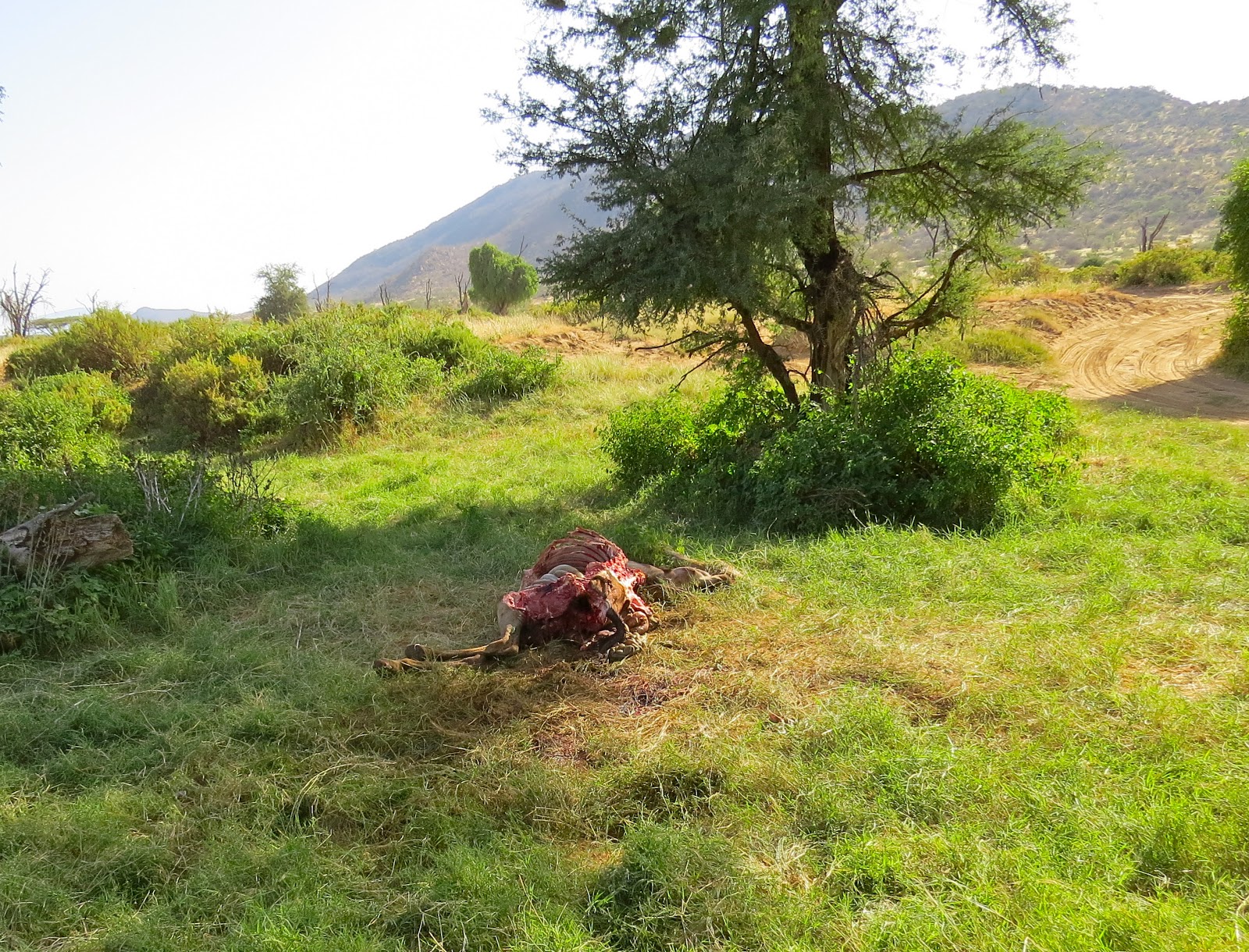
On our way out of Samburu on the last day, we had one more game drive. We'd heard a camel had been killed by a lion the day before. The camels live on the other side of the river, but apparently this one had crossed the water, to his peril. The guides talk to each other in the evening, and by radio, so Peter knew where to look to find the remains of the camel.

We passed by a crocodile. These animals have no sweat glands, so they open their mouths to cool off.


As we approached the site of the lion kill, we saw it was clearly marked by a tree absolutely full of vultures.


Peter explained that the vultures wait until the lion has had its fill. Then other scavengers come around to share in the feed. At the end, the hyenas eat the bones. It's a very efficient system, the wilderness.

A short distance away, a cheetah had been sighted in an open area. We found it without much trouble. Sometimes a couple of safari vehicles parked near each other is a good indicator! The cheetah was sitting quite still in the grass near a small tree. Peter told us the cheetah was beginning its hunt. It could see a couple of gazelles about 400 yards away. The best distance between a cheetah and its prey is much shorter; though the cheetah can run 60 miles an hour, it's a sprinter. So the animal approaches stalks its prey quietly and patiently until it's within 33 to 98 feet, a range with a good possibility of success. Over the 15-minute period we watched, the cat moved forward twice, never taking its eyes off the prey ahead. We would like to have stayed to observe the whole hunt, but we had a schedule to keep on departure day from Samburu.


Thursday, May 30, 2013

On safari: The Bag Lady learns about Kenya

Of course we are seeing the animals. But we're also learning about the country and people.  Here's some of what I've learned.

1. Kenya, in East Africa, has a population of about 40 million, from 42 tribes (or "communities). Many Kenyans speak English - the language of the British who colonized the area - or Swahili - or a local language. They speak with variations of "British" accents, some harder for me to understand than others.

2. If you stay in a Nairobi hotel near the government buildings and are eating in the restaurant, you will observe many men in black suits having business conversations. You may also observe them having conversations with Chinese businessmen. China is a major economic presence these days.

3. If you eat in restaurants you will have an excellent selection of fresh fruit to choose from. You will usually leave the breakfast buffet feeling quite nourished. At dinner, you may not be able to eat all the courses presented to you.

4. If you decide to have a cup of warm tea at a curio shop alongside the road instead of a bottled soda, you will regret it all night long, even if while you get up to go to the bathroom numerous times you see hyenas, mongooses and elephants outside your window. That was Art's experience, at least. I missed the gettings up, the hyenas and the mongooses. But not the elephants!

5.  Jet lag is easier to deal with when you arrive at your African destination at 8:30 p.m., just in time to go to bed, than when you're getting to Europe in the morning and have to stay awake all day. It helps to take No-Jet-Lag every two hours on the airplane. That was actually a surprise to me.

6.  The most pressing need of the Kenyan people is the education of their children. Public education is free until the sixth grade, but after that families may struggle to pay for the uniforms, books and schooling of their children. Especially in the rural areas, families may need their children at home for such activities as herding the family goats and cattle.

7. Girls in rural areas may not have as many opportunities to be educated. They may be married off young, or they may miss a month or more of school following female circumcision, which is sometimes a rite of passage similar to the circumcision of boys of the same age. Among the middle class the girls are educated as well. There is currently an educational program in place within the country to encourage alternative rites of passage for girls.

8. Public transportation is handled by "matatus"or minibuses. Usually crowded, sometimes quite battered, these smaller buses are cheaper to operate than larger buses. In the city, the drivers can be quite reckless. The traffic is bad enough without them!

9.  A driver/guide on a safari is a wealth of information about the people, the history, the animals - even while they are keeping a very close eye on the road. In most places, the roads are quite narrow, with paths alongside for the many people walking. And in the rural areas most roads are unpaved. 

10. Morning noises in the countryside are different from home. Right now I can hear unfamiliar birds, roosters, goats and a donkey.

Here's where we'll be for the next three days:
http://www.heritage-eastafrica.com/tented-camps/samburu-intrepids/