Tuesday, June 4, 2013

On safari at Sweetwaters Tented Camp and the Ol Pejeta Conservancy

Sweetwaters Tented Camp, where we stayed for two nights, was larger and more commercial than Samburu Intrepids Club. We most liked a couple of things about it.

  • Electricity stayed on 24 hours a day. The Samburu facility was run on generators, which shut down between midnight and 6 a.m. For two people who sleep with CPAP machines, this meant the lodge supplied us with an inverter during the dark hours. 
  • No mosquito netting around the bed. Sometimes when you wake up in the middle night, not quite sure of where you are, mosquito netting can be confusing to find your way out of!
However, this facility had a more crowded dining room and noisier guests, a professional but not overly friendly staff.

Our room looked out on a savannah; yesterday when we came home from our morning game drive there was a giraffe just across the ditch looking our way.

Here's a sampling of the animals from our three game drives:

A nesting eagle.


The male eagle sitting on a branch.


An oryx.

 Grant's gazelle. You can tell because the white on its butt goes above its tail.


Black rhinoceros. It differs from the white in the shape of its head and mouth. This rhino is a browser; it has a pointed upper lip to help it get leaves from the bushes. Its babies follow behind.


Here's a short video of a rhino family.


Waterbuck.

Some kind of spoonbill. 

Jackal. These animals mate for life.


Common zebras. Their protection from predators is that each is uniquely striped, and when grown they are all the same height. So when they're herded up and running, the predator can't identify which animal it is chasing. 


Gerenuk. This antelope browses on its hind legs. It gets moisture from the leaves rather than drinking water.


 Male ostrich.

The female ostrich is ruffling her feathers; she's interested in mating. The male is not.


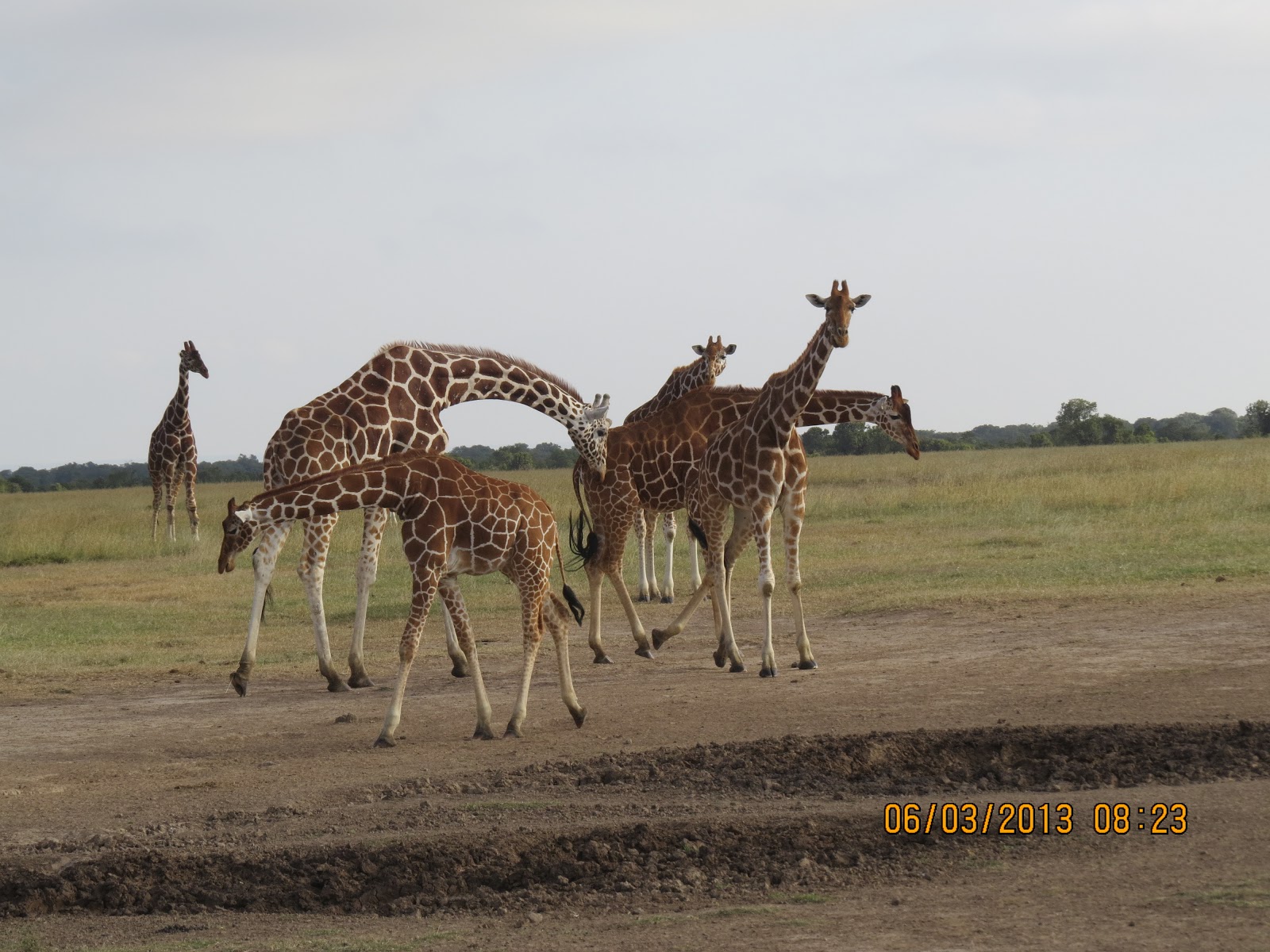
We came upon a group of 21 giraffes. 


The male was interested in the female in heat. He followed her closely. This behavior continued for at least ten minutes. As the other 19 giraffes moved on, these two remained. After two unsuccessful mating attempts, we drove off to give them some privacy!

The Conservancy has a chimpanzee rescue sanctuary, where abused chimps from all over Africa live. It also maintains a blind rhino. Oddly, the second blind rhino we've seen on this trip.


This was a long day!

Monday, June 3, 2013

On safari: The Unity Women's Village

Near the gate of the Samburu Game Reserve, the Unity Women's Village was established as a safe haven for women who have been abused, and for their children. Art and I had told Peter, our driver/guide, that we were interested in giving financial help somewhere in Kenya. We're particularly interested in assisting women or in providing an educational opportunity to children. Peter suggested we stop at this village.


We were welcomed by Rose, who speaks English, and by a group of women who danced for us.


Women in this village support each other. No men are allowed. If a woman starts communicating with her husband again, she will be asked to leave. Samburu women have many responsibilities in their villages, including building the houses, so these women are self-sufficient in their village.

Village women speak in other villages about women's rights. For them, that means young girls cannot be forced to marry old men, and genital mutilation - female circumcision - should not be happening. Quite different from the kinds of issues considered "women's rights" in the United States.

We visited one of the women's houses.


The house has two rooms. One room is for the woman and her female children. The other room is for the woman's male children. If she has no boys, no one sleeps in the room.


I commented that the woman of this house was tidy. Much tidier than I am in my house. The women laughed. 


Gladys also speaks English.


The village has a small market where the women display and sell their hand-worked items. Regardless of whose work is sold, the money is shared among all the women. We bargained for four pieces we liked as souvenirs. Their starting price was six thousand shillings ($70.51) and mine was four thousand ($47). We ended up at five thousand ($58.75). When the money had exchanged hands, Rose gave me three extra beaded bracelets. I'm not much of a shopper, but I figured these purchases were for a worthy cause.


The women said goodbye with a dance.


One of the women's goals is to send their children to school. At present they have children in primary and secondary school and one of the boys is going to university.  Brent Bruyere, an assistant professor at Colorado State University, has set up the Samburu Youth Education Fund for donations for the education of promising students in the Samburu area, in this village and others. You can read about Bruyere's projects here. Art and I have decided to contribute to the education of Kenyan students through Bruyere's organization.

Sunday, June 2, 2013

On safari: Samburu Intrepids Club - in and around the lodge

Disclaimer: Art is taking all the pictures on this trip!

Here at Samburu Intrepids Club we really feel like we're in Africa. The main lodge section is built from logs, with an open-air roof. The rooms are permanent large tents atop wooden platforms by the river. Inside our tent is a queen-sized bed and a bathroom. Our tent steward, Duncan, does "turn-down service" for us each evening. That includes draping mosquito netting around the bed so we're enclosed and protected from any insects that might be present (we've found one spider and three ants in our sink, but nothing else). In the morning, Duncan brings us coffee and cookies with our wake-up call. When we're out of the room in the morning, he straightens the room and ties up the mosquito netting around our bed. We have enough space to do our exercises and strew our usual travel clutter about the room.

When we first arrived we were told that vervet monkeys would try to get into our tent. To prevent that, when we were leaving the tent we should zip closed the inside and the outside doors, set the welcome mat upright against the tent, and secure it with the small table on the deck just outside our tent. Apparently the monkeys don't have the body strength to move the table! We were conscientious in following these instructions.

On our second morning, Duncan brought coffee and cookies to our tent with our wake-up call. We'd decided to skip the morning game drive because I'd been up in the night with my turn for "traveler's illness". Duncan left the tent, zipping it closed behind him. Five minutes later I opened my eyes. The first words out of my mouth for the day were, "Art, there's a monkey in our coffee." A vervet monkey had unzipped the tent and was grabbing all the sugar packets. Apparently, to the monkey, a sweet treat trumps people still being in the tent!

Later that morning, in a conversation with Duncan, I learned he is of the Luo tribe, the same as President Obama's father. I had brought an Obama T-shirt from the 2008 campaign. I asked him to give it to his daughter, Joy Margaret. Duncan lit up. He said, "She will be overwhelmed." He said he would tell her it is a gift from Mma Linda from America. I knew I'd find the right time to give this T-shirt to a Kenyan.

We spent hours during the day on the deck, watching and listening to the happenings on the other side of the river. The far bank is not on the game reserve; we were watching the activities of the Samburu people who live there. The Samburu are semi-nomadic pastoralists. Cattle, sheep, goats and camels are very important to their culture and way of life.  


The resort staff was attentive and friendly. A Samburu naturalist took Art and me stargazing one night; it was the first time we had ever seen the Southern Cross. Another Samburu man played his flute at meals; another carried a slingshot to keep the monkeys away from the eating area. Still another cared for an orphan ostrich living at the resort.


We were told to bring insect repellant along. So far we haven't needed it - or the socks I packed to cover my feet at night. However, it is warmer than I expected here at Samburu - in a dry climate - and I am wearing my safari hat every day. And always, always sunscreen!