Sunday, July 17, 2022

Ports of call, Part 1 - Spain, Morocco and Portugal

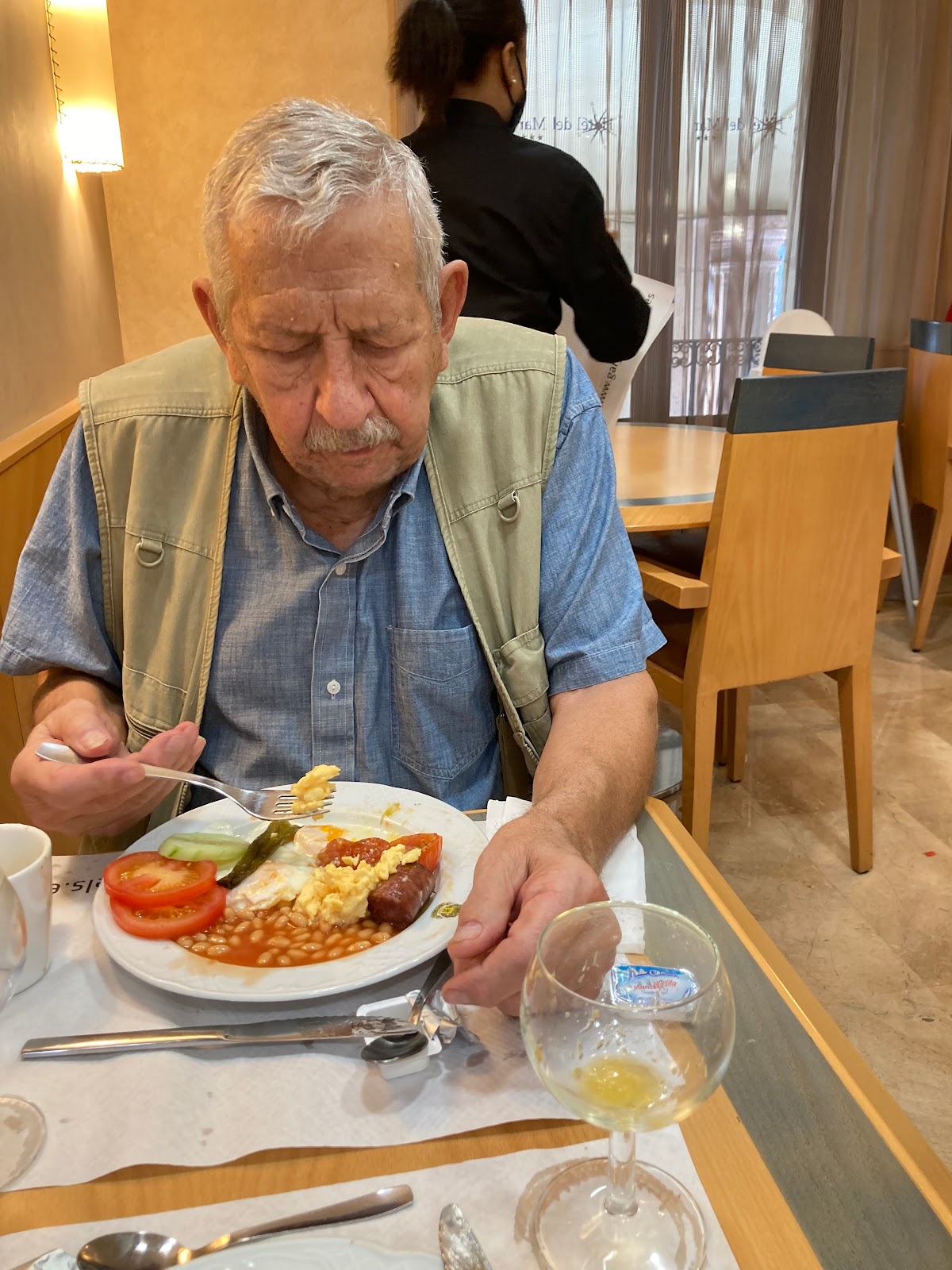
We flew to Barcelona, Catalonia, Spain, a day before the Aegean Odyssey embarkation and stayed at the Hotel Del Mar, near the port. A smallish room but fine for us to catch up on the time-zone difference. And a great breakfast buffet, with conversations in multiple languages around us.
The next afternoon, we took a taxi to the pier, got our passwords checked and temps taken, and took a quick Covid test before we boarded the Aegean Odyssey. Between that time and end of the cruise two weeks later, in our group of 24, eight people tested positive. They were quarantined in their cabins until they tested negative. Passengers were required to wear masks in all the public rooms and on public transportation. We were grateful to escape the virus during the cruise.


The first tour day our "relaxed" group (one of eight separate 25-person groups in this Road Scholar tour) took a panoramic bus tour of Barcelona, exploring the sites of the 1992 Summer Olympics. I wondered, in that congested area, how the Games accommodated the traffic.

The tour on the second morning was to the Picasso Museum, where many of the artist's early works are displayed. 

He was self-taught until the age of 16, then went to school to learn the traditional methods. He was a prolific sketcher; this wall displays only a small number of them.

It was a half-mile walk from the bus to the museum and back. Art passed on this field trip. Using my cane made the walk doable. I'm not much of a fan of art museums, but we had an excellent guide who made this one interesting.

***************

The Aegean Odyssey left Barcelona that afternoon for a day at sea on the Mediterranean passing through the Strait of Gibraltar, which separates Europe and Africa.  We disembarked in Tangier, Morocco. It's historically a city for international trade. Our relaxed group skipped the hilly climb to the Medina, the old city and marketplace. Instead, we visited Cap Spartel, a lighthouse tower near where the Mediterranean Sea meets the Atlantic Ocean.

We also went to Hercules' Cave, of archaeological and mythological fame. I was proud that Art and I both managed the walk on the downward-sloping stones. 

And an extremely rough night and day at sea, when we were advised not to move around on the ship any more than was necessary. We appreciated the grab bars in the shower and in all the hallways.

***************

Porto, our next port of call, is the second largest city in Portugal. In the medieval Ribeira district, narrow cobbled streets wind past merchants' houses and cafes.  


I stopped in a tourist shop near the cathedral. Small shop, MANY items for sale! 


***************

Our next port of call was Bilbao, Spain. I had never heard of this city, in Basque country, and I wonder why that is.  

From Wikipedia: "Bilbao is one of the most important ports in Spain. Beginning in the 1870s, Bilbao experienced rapid industrialization based on the export of iron ore and the development of the iron and steel and shipbuilding industries." Thirty years ago it was a dirty and polluted industrial city. The industry is no longer dominant, and the city has become revitalized. The significant amount of money spent came from the EU, from taxes remaining in the region rather than being sent to the central government, and land sales available because many companies went bankrupt and had to sell their properties to pay taxes. 

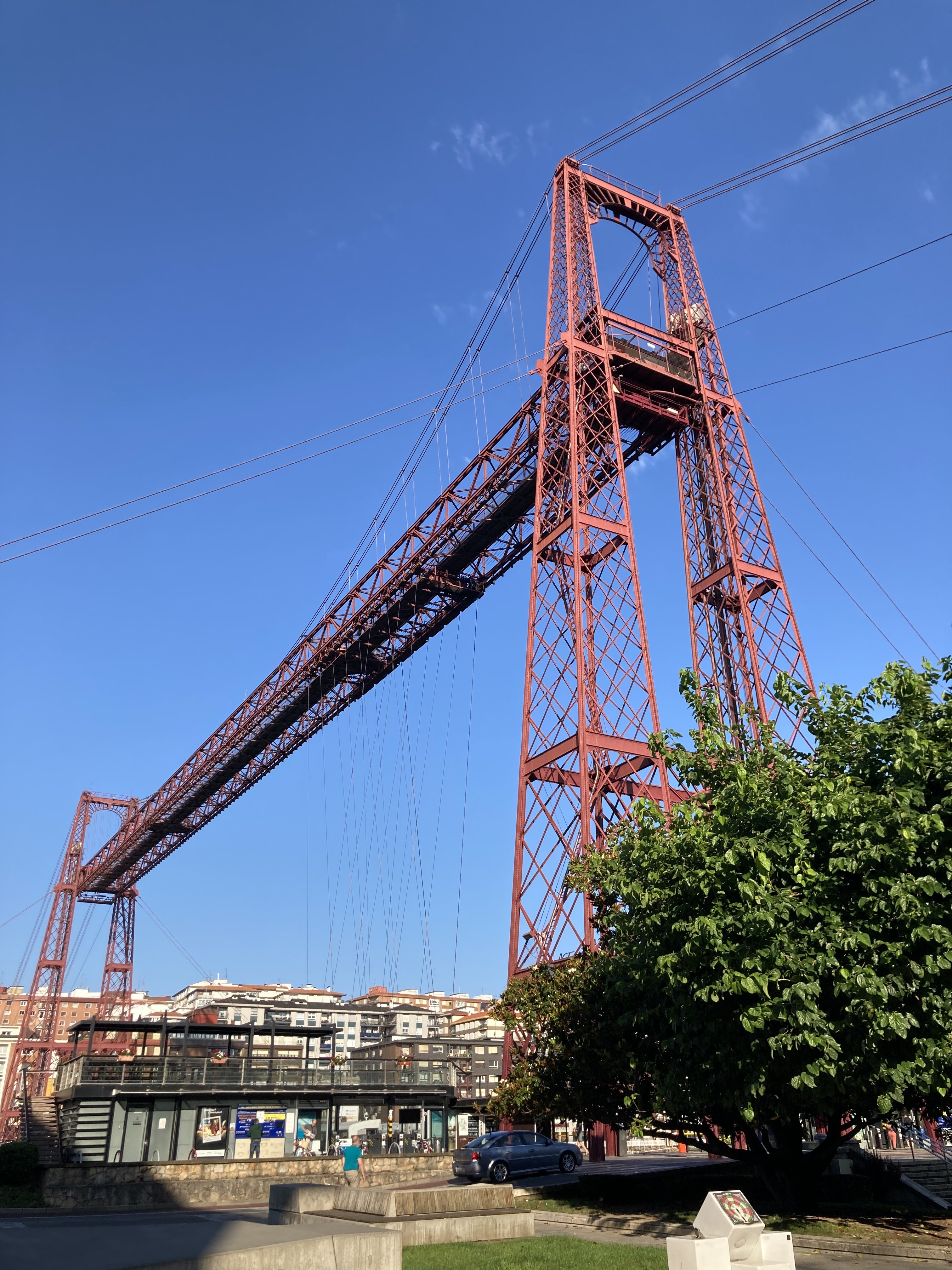
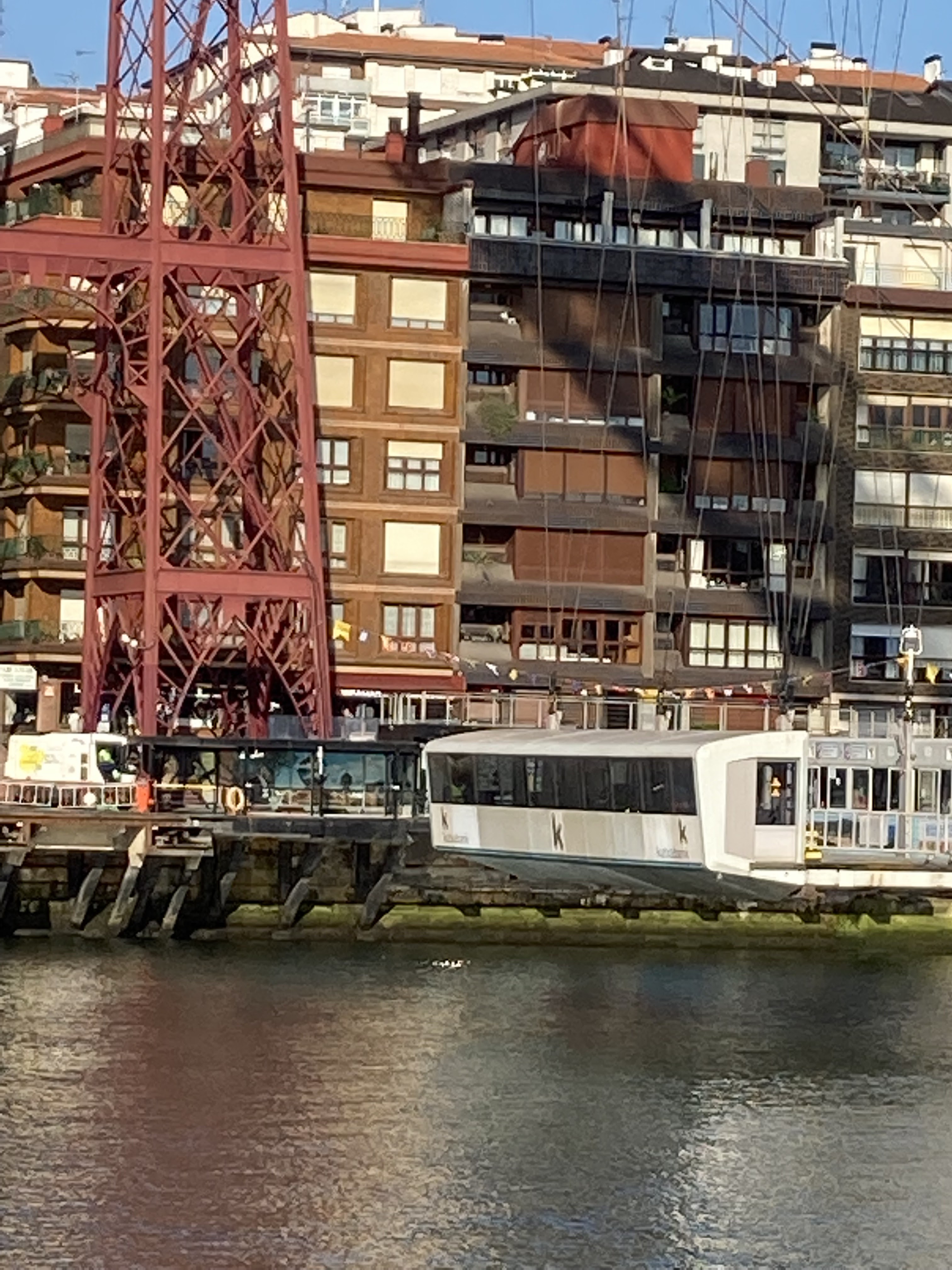
We drove from the port up the river, so we could see where the old industrial sections had been. Our first stop was at the Vizcaya Bridge, the first ever transporter bridge built in the world, and one of the few surviving examples. It's a UNESCO World Heritage Site. The Vizcaya Bridge connects Portugalete and Getxo, two port towns along the Bay of Biscay. It's like a ferryboat suspended from a bridge.
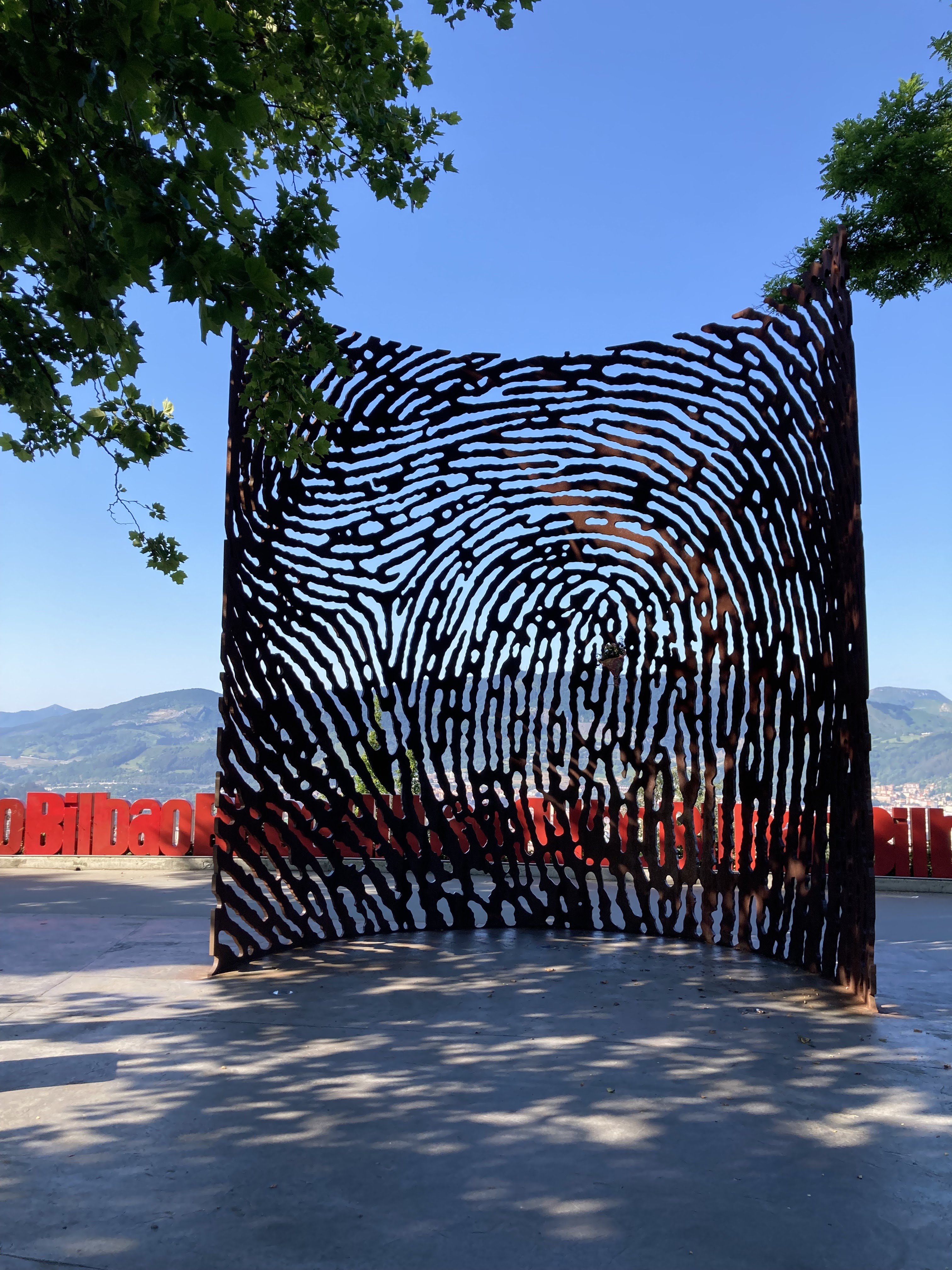
There's a hilltop park that overlooks the city. We could see the revitalized river area and the Guggenheim Museum. As we stood at the railing, I said to Art, "I could live here." 


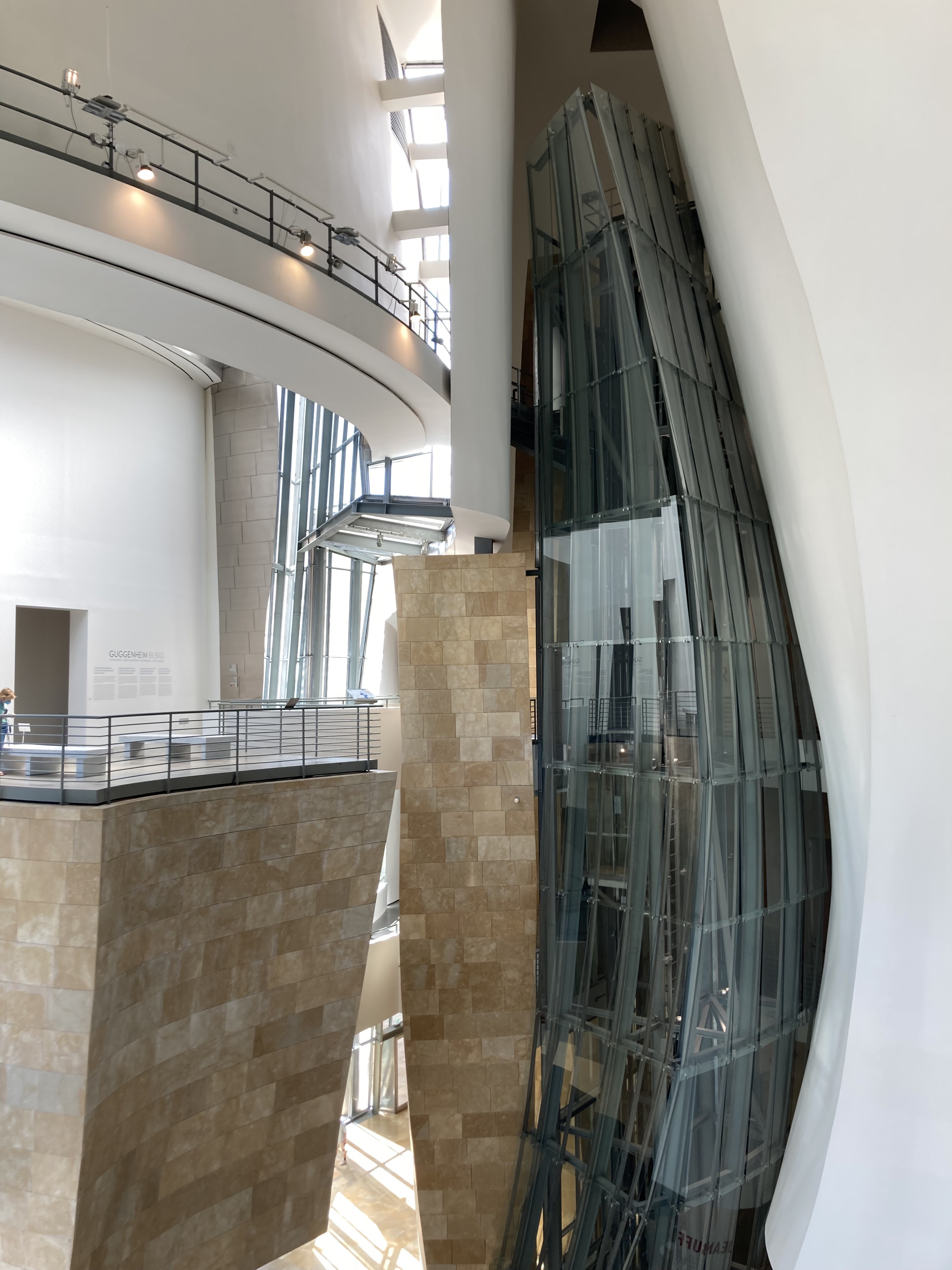
I'm not much into art, but the Guggenheim Museum was impressive. I love how the building is designed. I can't imagine how an architect's mind works to create "unconventional" structures. 


Here's just one of the exhibits: 


I took this photo - in the gift shop - because the people, hands in pockets, looking up, looked like I felt when I looked around the museum, from outside and within it.

Here's a link to a Lonely Planet article about how the museum came to be.

Ports of call, Part 2, coming soon.


Friday, July 8, 2022

Going, going....

Gone!

Neither Art nor I got covid - though my son James, who lives upstairs, did. Fortunately, we hadn't seen him for three days before he got symptoms.

Art's physical therapy is going very well. Most of the time he's standing upright, rather than bent over as he was before. He's becoming "conditioned" again.

I went to the ortho clinic on Monday, got a steroid shot in my knee and an "offloading knee brace" to minimize the discomfort when I walk a distance.

I said to Art, "Are you looking forward to this trip?" He said, "Yes. I thought for a while you weren't going to want to go, so we wouldn't be going." I said, "That's because I didn't know if you would be strong enough." He rolled his eyes. I guess he was feeling better.

I'd read that lots of flights were being canceled and that there was a great shortage of baggage handlers at Heathrow and other airports, and that passengers were being advised to pack three days of clothing in their carryons. So we did that. 

We got everything into four suitcases, and made reservations for Uber to get us to the airport. Once there, we asked British Airways for wheelchair assistance for Art, both in Seattle and at Heathrow in London for our connection to Barcelona. We couldn't have asked for more attentive treatment. 

Business class is fabulous! 

I'll be sending out two more blogs about our trip: one with pictures for our seven ports of call and the other with my "what I learned on this trip" list.

Wednesday, June 1, 2022

To go or not to go

We leave for Europe in three weeks for a two-week Road Scholar cruise. We fly from Seattle to Barcelona where we board a small ship (350 passengers) that visits Spain, Portugal, Morocco, France and England. We made this reservation last November. Knowing that we'd both had surgeries during the previous summer, we splurged big time on business class airfare so we could fully recline and sleep on the ten-hour flight between Seattle and London, and we'll arrive in Barcelona a day before the trip starts to minimize jet lag.

Passengers on the trip choose "relaxed" or "discovery" events and are assigned to groups of 35 people for the entire trip. Since Art and I are still not fully recuperated from summer surgeries last year, we both use canes when we walk outside the house. So we chose the "relaxed" group which doesn't involve as much walking.

Then, in late February, Art developed sepsis and spent a week in the hospital. He is still recovering from that illness. His doctor described him as "deconditioned", which is "a complex process of physiological change following a period of of inactivity, bedrest or sedentary lifestyle." He was also very low in vitamin B12 at his wellness exam last month, so he's begun getting injections. He has already reported more energy after just two shots. He finally got a physical therapy appointment for this week. He's getting stronger, but it's a slow process.

When I think about the amount of energy traveling requires I wonder whether it's wise for us to take this trip. I looked at the cancellation policy included in the Road Scholar contract. We could cancel it any time before the date of travel, for any reason, for a full credit, to be used in the next 18 months. And British Airways will give a credit to be used in the next year.

I also looked at the travel insurance we bought. Full cancellation with refund can be had if someone dies, or for a sickness or injury that: a) occurs before departure on your trip; b) requires medical treatment at the time of cancellation; and c) as certified by a physician, results in medical restrictions so disabling as to cause your trip to be canceled. Using this insurance would allow a full refund for both the cruise and the airfare.

So, I'm pondering. After a couple more weeks we'll decide. Right now, for me, it would be almost a relief to cancel and reschedule for a year out. For Art, it doesn't seem to be an issue. I asked him last month if he still wants to do this trip and he said, "We haven't been to any of those places." He wants to go.

Sunday, May 8, 2022

Airport driver

Last month I dropped people off at the Tucson airport 12 times.

I volunteer for The Inn of Southern Arizona. We provide food, clothing and shelter for documented migrants traveling from the southern US border to the homes of sponsors elsewhere in the US. I've served on the board for the last year.

Before covid, my husband Art and I volunteered every Saturday night at the shelter. It was then located in the basement of a Methodist church in Tucson. Cots were set up for families, and meals were prepared and served in the church kitchen. When families received bus tickets from their sponsors, they were taken to the Greyhound bus station for their onward journeys. 

More than a year later, we reopened - this time in a motel just off Interstate 10. For the sake of safety, families were housed in individual rooms, and volunteers knocked on the door to deliver meals. Everyone wore masks and observed social distancing. All our guests had tested negative for covid; those migrants testing positive were housed at another shelter until their tests were negative.

Now, most of our guests fly from the Tucson International airport to the cities of their sponsors. 

I haven't volunteered on site much this year because it's hard to be on my feet for the four-hour shift; I'm still recovering from my hip replacement last summer. But I offered to be an airport driver. I'll get a text from Elsa, coordinator of the drivers. "We've got a family of three leaving at 3:30 p.m. Can you take them to the airport, help get their boarding passes, go through security with them, and take them to their gate?" 

I've learned that if I'm going through the airport with families, it will take two hours and 55 minutes from the time I leave my house until the time I get home: 35 minutes to the motel to pick up the family, 20 minutes to the airport, an hour and a half from the parking lot to the ticket counter to security to the gate to the family boarding the plane, 30 minutes back to the parking lot and then back to my house.  So if I have an afternoon free I can say yes. 

My Spanish is pretty limited, so I have Google Translate on my phone. I've recorded a few messages:  "I will take you to the ticket counter and help with your boarding passes" and "I will take you through security" and "I will stay with you until you get on the airplane." I show them the message in Spanish on my phone and they nod. Or I read them the message in my not-too-terrible Spanish.

At the ticket counter there is usually an agent who speaks Spanish. I get a gate pass there. At the TSA checkpoint there is always a Spanish speaker, who looks at the family's documents and takes their picture. They look at my driver's license and take my picture. We go through security. I take off my shoes and say, "No zapatos". We go to the gate and wait. Sometimes one of the family speaks a little English and we have a simple conversation. Sometimes we use body language to communicate. When the family's boarding row is called, the adults usually give me a hug and thank me, like I am the one responsible for their upcoming new life. Sometimes they cry. When they're about to board the plane, they look back at me and wave, and I wave back. 

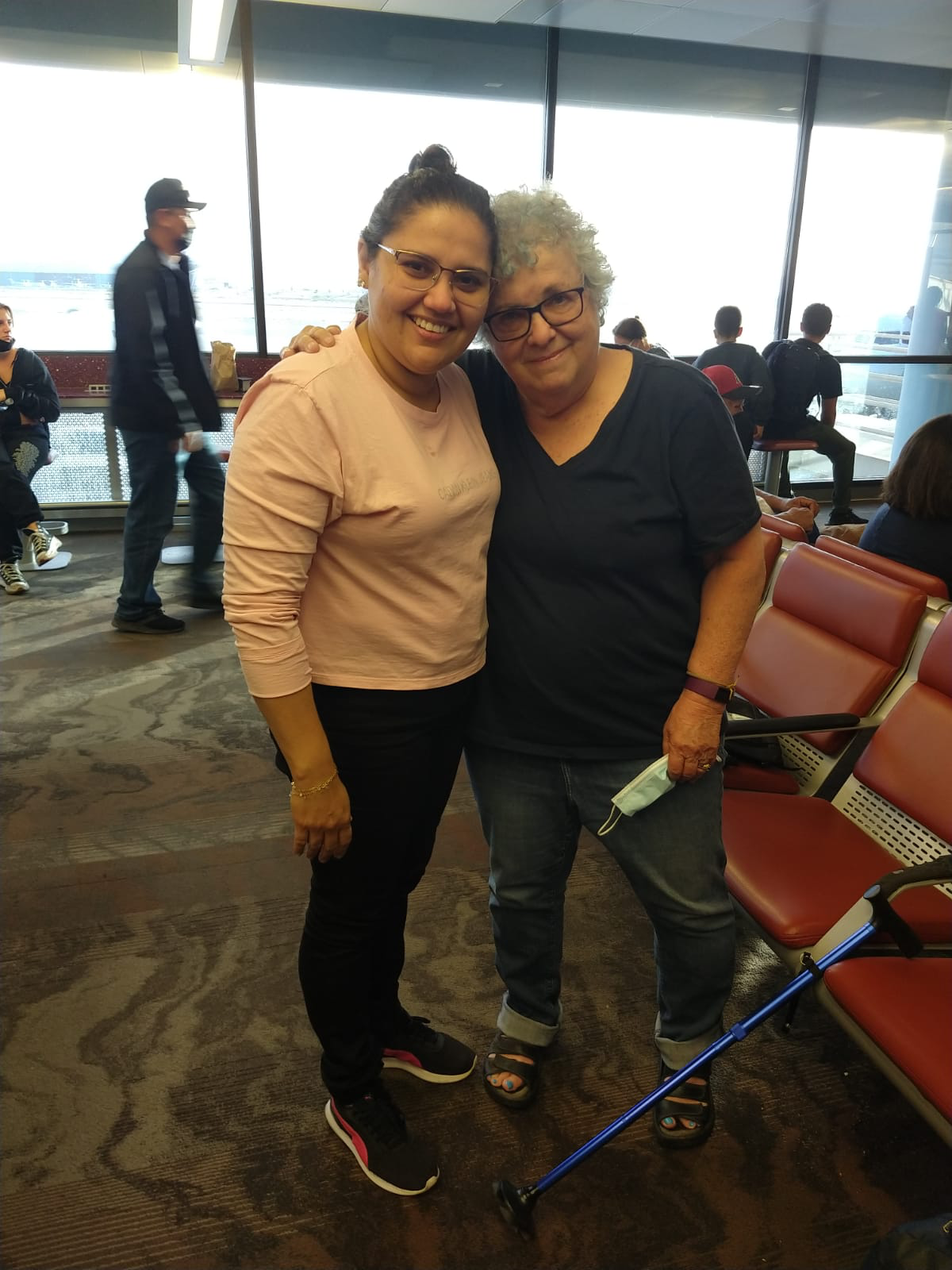
I have taken families to the airport who are from Cuba, Colombia, Venezuela, Haiti and Brazil. The young woman in the Brazilian family talked to me via Google Translate Portuguese. Her mother died nine years ago. The family had to leave the rest of their family behind in Brazil. She cried as she told me the story. I said, "I don't understand all of your words, but I understand your heart." I put my hand over my own heart and she nodded. Her name was Priscilla and she wanted my phone number so she could text me to tell me they had arrived safely. I got a text from her yesterday, with a photo her husband had taken of us.


Volunteer driver coordinator Elsa may also say, "We've got two families leaving at 11:45 a.m. We have another volunteer who will take both families through the airport, but the volunteer doesn't have enough room for everyone in their car. Can you take the second family and drop them off at the airport to meet up with the other volunteer?"

I know this will take me an hour and 15 minutes, so it's usually an easy "yes". 

I love this volunteer work. It makes a difference to a single person or to a family. It is easy for me. I get more than I give.

"Todos somos iguales." We are all the same.


Sunday, April 10, 2022

The most embarrassing moment

I wrote this piece about ten years ago. Still the most embarrassing moment of my life.


My mother was somewhat of a snob. Not intellectually, for sure. Not even socially, for the most part. She was a high school graduate who made good by marrying a career military officer. From her position of safety, she was free to cast judgment upon others. And she taught her daughters well to do likewise.


"Tacky" was an especially dismissive term reserved for artwork in a house that differed from what she liked, unattractive wardrobe accessories worn by others, the exterior maintenance of a house that was other than what she would have done. "That is so tacky" was the ultimate scornful statement.

One of the most scorned yard treatments when we lived in Southern California was plastic flamingos on a front lawn. Whether a solitary bird or a flock, all of us pointed and laughed when we saw them. In our family it was almost like looking for license plates from different states while you're on a road trip. "Oh, look! SIX flamingos over there." Heads swiveled as we took in the tackiest of tacky sights.

As is usually the case, I strove mightily to cast off my mother's less attractive teachings. I didn't gossip, didn't speak harshly to family members, and reserved the silent treatment for only the most deserving situations. 

Many years later I had moved away from California and now lived in Washington State. I obtained a professional degree and was employed in a respected occupation with a salary that provided me with more than the necessities of life. I worked for a company that developed software programs for the educational institutions' administrative needs - for example, payroll, financial accounting and student scheduling. From time to time I would be sent into the field to train people on how to use the features of the software.

On one project, we had worked for several years to develop a new financial system and it was time to train the first district on its use. The suite of applications was called WISE (Washington Information Systems for Education). As a person logged into the system, a blinking owl greeted them (you know how an owl is WISE). It was in the days before graphics were sophisticated; back then the pictures were created using the characters on a word processor.

I drove to Puyallup to spend the day with the accounts payable clerk in the school district office. I'd been told she was reluctant to be changing how she did her work, so I wanted to approach her with compassion and a bit of humor to make the process easier. Her name was Darla, and I found her in a tiny office in the back of the building. I sat down with her and showed her how to log on. The computer was slow that day and the little blinking owl displayed for an unusually long time. To break the silence I said, "What do you think of the owl?" Darla said, "It's all right". I lowered my voice conspiratorially and said, "I think it's a little tacky myself - you know, like flamingos on someone's front lawn." 

And Darla said….

Yep. She said, "I have flamingos on my lawn."

I looked for a table to crawl under, but couldn't find one. Instead, I excused myself and slunk to the restroom.

I try to learn from my mistakes, so I have told that story many times. It was the most embarrassing moment of my life. Even more than when I had a tail of toilet paper tucked into my pantihose at work. And not just the toilet paper. The back of my dress. That probably happens to everyone at some point. When I talk about my horrible flamingo faut pas, I get to remember all over again that I was tackier that morning in Puyallup than a yard full of flamingoes ever could have been.

When we redid our yard several years later, I put a metal pink flamingo into the ground in the side yard, to remind myself. I wonder if people laugh when they drive by.

Friday, March 25, 2022

Looking back on some 2014 foolishness

 I wrote this in 2014, just eight years ago.

 My husband Art is six years older than me and for at least ten years he's been complaining about his aching bones. He's had a hip and a knee replaced, two rotator cuff surgeries and a hand surgery. Oh, and a pacemaker following a cardiac arrest last winter. He didn't use to seem that old to me. When we met we were in our 40s and he was trim and strong and nimble. Now he walks with a little hunch and groans a little when he gets out of his chair. Some days when he's cranky  all he wants to do is read the paper and work the puzzles and read in the living room, I ask if his arthritis is bothering him and he says yes.  

That is not going to happen to me. I know it isn't.

I've been healthy nearly all my life. When I was younger I broke my left arm and my left leg. Once in a while my back would go out, but it would be better within a few days. Usually it happened after I lifted something heavy. 

When I was 59 I ruptured my Achilles tendon working out at the gym. No big deal, the trainer said. I'd have surgery and P.T. and then I'd have a full recovery. So I had the surgery and did the P.T. and have, I'd say, about a 90 percent recovery. I don't have any pain but my right leg is smaller than my left. Something about the other leg compensating or whatever. Funny that didn't happen when I broke my leg at 23.

That same year I strained my SI joint. Maybe doing yoga, or maybe once when I slipped on an icy sidewalk and fell. My chiropractor took X-rays and pointed out that my lower spine is messed up and my pelvis is tilted. He said I was lucky I wasn't in any pain. But I was - for six months my SI joint hurt. We went to Paris for Christmas and I walked with a cane the whole week. Eventually I figured out I could go to the gym and work out on the elliptical trainer and get myself back into shape. I thought I'd recover completely, but the SI still bothers me seven years later when I'm on my feet too much in a day, or spending too much time in an airplane seat. I'm hoping it will get itself in order pretty soon. When I was younger my body always healed right up.

Three years ago I sat down in a chair that was two inches lower than I was expecting and I messed up my back. A light show of nerve sensations ripped down my leg from thigh to knee. Within half an hour my feet were tingling. I went to a chiropractor who said the sensations would pass within a few hours. They didn't. It's been three and a half years. The sensations are still there, though not as strong as they were at first. I hear it can take five years for these kinds of things to clear up and sometimes they never do get better. I think about my feet from time to time, especially when it's cold and they complain, but I don't worry. Everyone gets injured now and then, and I'm no exception. This doesn't have anything to do with getting older.

This summer I did so much watering of my garden that I strained muscles in my arms and legs. They're still bothering me. Really, it's annoying. This never used to happen to me.

I have other little odds and ends of physical issues. Nothing serious. I had one cataract removed a couple of years ago and will take care of the other one next summer. I try to get all my errands run before dark since I don't see so well at night. I'm a little stiff when I wake up in the morning.

But I'm never going to have aching bones like my husband. Not me. Nope.


Now it's 2022, and my story is different!

Now I have aching bones and I complain almost as much as Art. I had my right hip replaced last summer and, though it's healing, my low back and my left knee are complaining. Some days are better than others, of course. But some days aren't. And while we choose to live in Seattle from May to October, I already know that until the rain stops in late June, those aches will be quite bothersome.

I watch younger people in our Tucson retirement community - they're mostly in their 50s - playing tennis and jogging. And I remember how I felt at that age. They have no idea that the same thing will happen to them. Actually, they've been told it will happen, but they don't really believe it. Just like I didn't.

This afternoon I'll take an eight-mile ride on my electric bike. It will be so easy, with a little bit of pedal assist, that I'll be inclined to forget I'm one of those with aching bones. 

Until I get off the bike and climb the four stairs to our house.


Saturday, March 5, 2022

Not an ordinary week!

This has been a week!

A week ago today I got a video from my Afghan friends Shakofe and Nasar. Shakofe had arrived with her family in Turin earlier in the week, and her brother Nasar had driven with his wife and four children from Germany to be reunited with his sister, whom he had not seen in six years. I played the video several times, tearing up at least once, and feeling so glad for the outcome of Shakofe's journey.

Early in the afternoon I had an hour-long Zoom call with my sister and brother-in-law. My husband Art joined that call, and we talked and laughed together.

Then the carpet cleaner came. While he worked, I sat on the deck and read in the sunshine. I didn't know what Art was up to.  When the carpet guy left I went to find Art. 

He was lying on the bed. He said he felt terrible after half a dozen occurrences of vomiting and diarrhea. I took his temperature and it was 100.4. I gave him a covid test and it was negative. Within half an hour his color had changed to a grayish blue. I took his temp again and it was 102.1. Art said he had never felt so bad. By this time his voice was husky and his breathing was rapid and shallow.

I called the consulting nurse for Kaiser Permanente, our health care provider. She asked me a few questions, then asked to speak to Art. His voice was faint. I took the phone back from him. The nurse said, "You need to call 9-1-1."

I said, "Art, she says I should call 9-1-1." He said, "No." I said "Yes."

Ten minutes after my call to 9-1-1, the EMTs arrived at our house. Art's oxygen saturation was 83. Within 15 minutes they had carried him on a gurney to the ambulance and left for Banner University Medical Center.

Before I went to the hospital myself, I contacted several close friends; I knew I'd need their support for whatever came up.

By the time I got to the emergency room, Art was wearing an oxygen mask and receiving antibiotics. The doctor told me it was likely Art had a bacterial infection that had gotten to his bloodstream. When he arrived at the hospital he had severe sepsis - septic shock. 

The medical team at Banner saved Art's life on Saturday night with oxygen and antibiotics and expertise. A lab culture grew e-coli within two days. He spent the next four days in the hospital's Progressive Care Unit as the staff monitored his progress and administered IV antibiotics and fluids. I talked to the doctors and the nurses. They were all committed to educating us as to what was happening and the plan for Art's treatment.

By Thursday Art's medications were being administered orally and his supplemental oxygen was discontinued. And yesterday, Friday afternoon, he was discharged from the hospital. He'll be resting and recovering at home for the next week or so. Today he spent the day in his pajamas, watching TV. I went for take-out Thai soup, and as he ate it, his face lit up at the flavor. It's been a week since that last happened.

I called the Kaiser consulting nurse service and thanked them for saving his life. The nurse I talked to got a message sent directly to her. I called the ambulance service and thanked them. I have the name and email address of the administrator of the Banner hospital team. I will thank the medical team, through her, on Monday. It often happens that these lifesavers don't know the outcome of what they do. I think it's important to let them know.

Grateful, grateful, grateful!